
Galden® PFPE Fluids: Corrosion Resistance and Thermal Stability
Do Galden® PFPE Fluids Promote Corrosion?
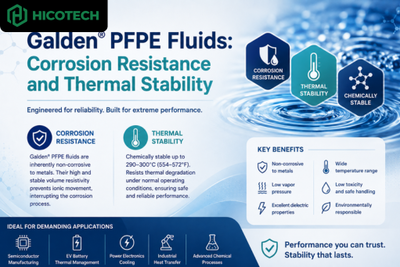
Galden® PFPE fluids are inherently non-corrosive to metals due to their exceptional electrical insulating properties. Corrosion typically requires an electrical pathway that enables ionic movement, but the extremely high and stable volume resistivity of Galden® PFPE fluids effectively prevents this process occurring.
In comparison, even deionized (DI) water, which initially exhibits a high resistivity of approximately 10⁷ ohm·cm, gradually becomes more conductive as it absorbs metal ions surrounding surfaces. Galden® PFPE fluids maintain their insulating characteristics throughout their service life, eliminating this corrosion mechanism.
When corrosion is observed in systems utilizing Galden® PFPE heat transfer fluids, it is generally associated with one of two unusual conditions: the presence of excess water or thermal degradation of the fluid.
Read more: What Are Galden Perfluorinated Fluids?
Corrosion Caused by Water Contamination
Galden® PFPE fluids have a very low water solubility, typically below 20 ppm by weight. Water dissolved within this limit has never been associated with corrosion issues. However, if the water content exceeds the saturation threshold, a separate water phase may form within the system. When this free water comes contact with metal surfaces, corrosion can develop rapidly.
Corrosion Caused by Thermal Decomposition
Under normal operating conditions, Galden® PFPE fluids remain chemically stable. However, if the fluid is exposed to temperatures above its decomposition range of approximately 290°C to 300°C (554°F to 572°F), fluoride-containing byproducts such as hydrogen fluoride (HF) may be generated, potentially leading to corrosion.
Such occurrences are extremely rare and are generally linked to equipment malfunctions or abnormal operating conditions, including:
Heater burnout
High-voltage electrical discharge in dielectric systems
Failure of electrical components in direct-contact cooling applications
Because these temperatures significantly exceed typical operating conditions, corrosion resulting thermal decomposition is seldom encountered in properly maintained systems.
How to Choose the Right Heat Transfer Fluid
Selecting the most suitable heat transfer fluid requires careful evaluation of two critical performance parameters: low-temperature viscosity and high-temperature vapor pressure.
Viscosity at the Lowest Operating Temperature
The fluid must remain sufficiently pumpable at the minimum operating temperature. For fluorinated heat transfer fluids, a viscosity below approximately 20 cP (11–12 cSt) is generally recommended to ensure efficient circulation and minimize pumping energy requirements.
Vapor Pressure at the Highest Operating Temperature
The fluid's boiling point should exceed the maximum operating temperature by at least 10°C (18°F). Maintaining this safety margin helps:
Prevent excessive system pressure
Minimize fluid evaporation and loss
Reduce the risk of cavitation
Improve overall system reliability and efficiency
By balancing these two parameters, engineers can optimize heat transfer performance while extending equipment service life.
What Is the Storage Life of Galden® PFPE Fluids?
Galden® PFPE fluids are renowned for their outstanding chemical and thermal stability. When stored in their original, unopened containers under recommended conditions, these fluids can maintain their performance characteristics for more than 20 years.
This exceptional storage stability makes Galden® PFPE fluids an ideal choice for industries that require long-term inventory management without concerns about product degradation or reduced performance over time.
Contact Information
Hotline / WhatsApp: +84 945 261 931
Email: Sales@hicotech.com.vn
Có 0 bình luận, đánh giá về Galden® PFPE Fluids: Corrosion Resistance and Thermal Stability
TVQuản trị viênQuản trị viên
Xin chào quý khách. Quý khách hãy để lại bình luận, chúng tôi sẽ phản hồi sớm